
Iterations 2022 - 2024
Iterations
5. Iteration (2024)
Change management is the key
On 29 August 2024, for the third time a so called Syntegration Workshop (German) on the topic “future competitiveness of the University of Bern” was held as part of the Fit for Future program. In the final edition of this kind, the goal was to validate the topics and projects and develop them further.
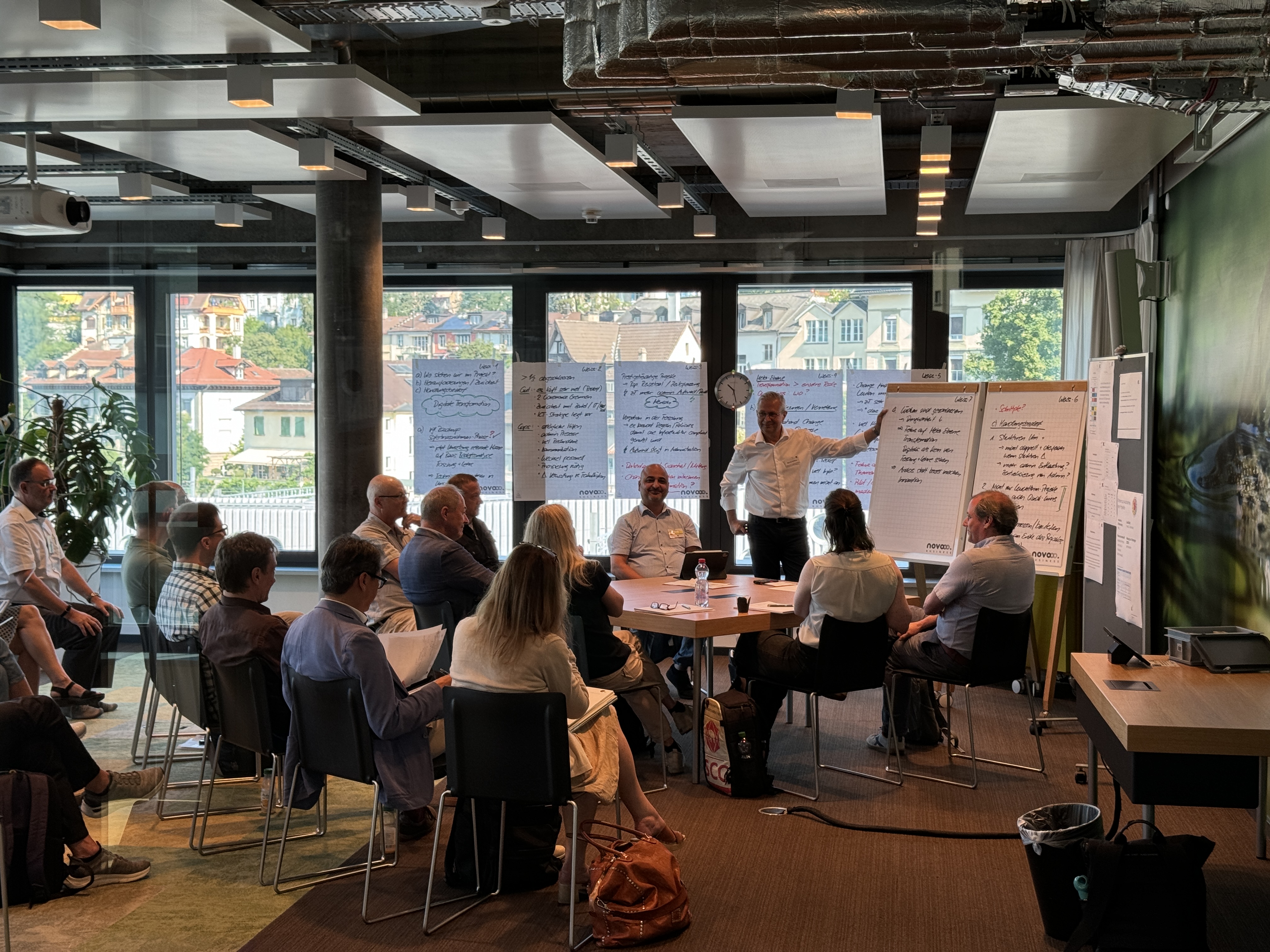
On 29 August 2024, the time had come again: members of the faculties and the central administration units, as well as representatives of the SUB and MVUB, came together to discuss what needs to be done today to ensure that the University of Bern will still be competitive in 20 years' time. In addition to discussing the status of the projects and the challenges, the aim this time was also to adjust the Fit for Future program by removing the projects from the action areas that have been completed, are well advanced or are consolidated in their progress.
In various group formations, the 12 FfF topics were the subject of lively discussion and informal exchange was fostered during the numerous short breaks - a major benefit of the event, in the view of Prof Myrach, Vice-Dean of the WISO Faculty. On the other hand, he finds it somewhat problematic that the participants in the individual group discussions do not always have a direct professional connection to the topic being discussed or have worked in the respective working groups. Naima Hillman from the SUB, who took part for the first time this year in the role of an observer and will represent the SUB at future events, could profit from the fact that she had already come into contact with many of the topics in her function at the SUB. Her impression of the event was positive: ‘There are huge challenges and it's stimulating to get so many perspectives at once.’ Irene Strobel, the new Head of Human Resources, was also there for the first time and enthuses that ‘as a newcomer, it was a great opportunity to immerse myself more closely in the topics and action areas, to get to know people better and to be able to exchange ideas’.

The action areas
While the direction of some action areas is undisputed and the projects are progressing or have already been completed, other project groups are facing bigger challenges. The most important statements from the group meetings on some of the action areas are summarized below.
Digital Transformation
The aim of the digital transformation should primarily be to simplify the working environment at the university and reduce redundant applications. On the other hand, an awareness must be created in the units of the central administration and in the faculties that the framework conditions (external requirements) of the university - e.g. with regard to data security and data protection or the demands of funders - entail additional requirements that must be taken into account. Employees must be accompanied through the transformation by appropriate change management - fears and concerns must be listened to and taken seriously.
New workplace concepts
In the project “new workplace concepts”, a pilot was launched in the Building development office and in the Facility Management office in 2024. Project manager Fabian Lüthi reports that the response was mixed and the intensity of the resistance had been underestimated. The group discussion is also controversial. Everyone agrees that the topic of ‘space and room allocation is closely linked to the topic of leadership responsibility and that it is important for managers to be prepared to give up their individual offices. It is equally important to take into account the different ways of working at the university, to identify needs and to incorporate them into the various models. Critical voices doubt that a daily change of workplace will contribute to the attractiveness of the University of Bern and point out that it is difficult to do justice to all employees in an open-plan office. In some larger companies, the ‘New Work’ concept has already been abandoned. Nonetheless, it is necessary to react to the scarcity of space and, where possible, to respond to the changed forms of working and make positive use of the reorganisation.
UniBE Life
The group agrees that there is still room for improvement in terms of shared values and the sense of belonging to the university as a whole among the employees. Managers need to take responsibility and further measures such as the implementation of ‘Welcome Packages’ should be considered as identity-building ways for new employees to join the university. Also regarded as desireable are more unifying events such as the ‘Night of Research’, which help to overcome the boundaries between faculties and central units.
Shortage of space
So far, efforts to obtain more space or to realize building projects have met with little success. The University is dependent on the Canton of Bern, which does not have the necessary financial resources to realize the projects. At the same time, the university lacks the lobbying power to apply sufficient pressure through politics.
To bridge the gap, interim uses ( “Bettenhochhaus” Insel / Tiefenau hospital) have been examined, but unfortunately without success, as the room structures do not meet the requirements of the University of Bern. Locations outside of Bern would not reduce costs either, as laboratory space in particular is required. The only scope for action at university level is therefore the optimized use of existing premises and the creation of collaborations.
In order to achieve more significant improvements, systematic lobbying is necessary, which must be underpinned by good figures in order to be able to substantiate the shortage of space; it is also recommended that more quality arguments be put forward to political decision-makers.
University structures
Following the consultation phase and the summer break, the project and its sub-projects now need to be initiated. The central objective is the introduction of departmental structures in the faculties and the subsequent bundling of administrative tasks.
Rector Virginia Richter is aware that the changes will have a major impact on the everyday lives of faculty members, which is why careful monitoring and communication is essential.
The reorganization within the Faculty of Humanities, in which a new department was established due to the crisis in the ISNO (housing Middle Eastern Linguistics and Cultural Studies, Religious Studies, and Social Anthropology) is seen as an opportunity. In order not to lose sight of the goal of simplified processes, solutions must be found for the faculties that take their diversity into account, but nevertheless provide harmonised structures in administrative aspects.
Leadership culture and change management
Up to now, the main focus has been on leadership training, which manifested itself in the CAS Academic Leadership. Additionally, Prof. A Hack was engaged to help establish professional change managementby conducting interviews with members administrative units, from which measures are now to be derived.
The group emphasizes the value of the CAS and the courses that can be taken individually, but fears that it is often those who particularly need it who do not attend these courses. It was noted that there is no actual university leadership mission statement, although the university's values are set out in the principles of Strategy 2030.
Information on the current status of the other action areas can be found under the following links.
- International research environment
- Teaching
- Life-long learning
- Innovation und Knowledge Translation
- Conditions of employment
- Equal opportunities
What happens next
In addition to the status of the projects and the discussions about the challenges facing the action areas, the participants also considered how the Fit for Future programcould continue and which aspects should be given greater consideration. The importance of communication and change management, the prioritization of projects and the exchange of best practice were mentioned particularly frequently. The suggestions will now be considered by the Executive Board of the Univerisity and the program will be adapted accordingly. It was agreed that the Fit for Future program should continue to provide a format where ideas can be shared across organizations and stands.
4. Iteration (2023)
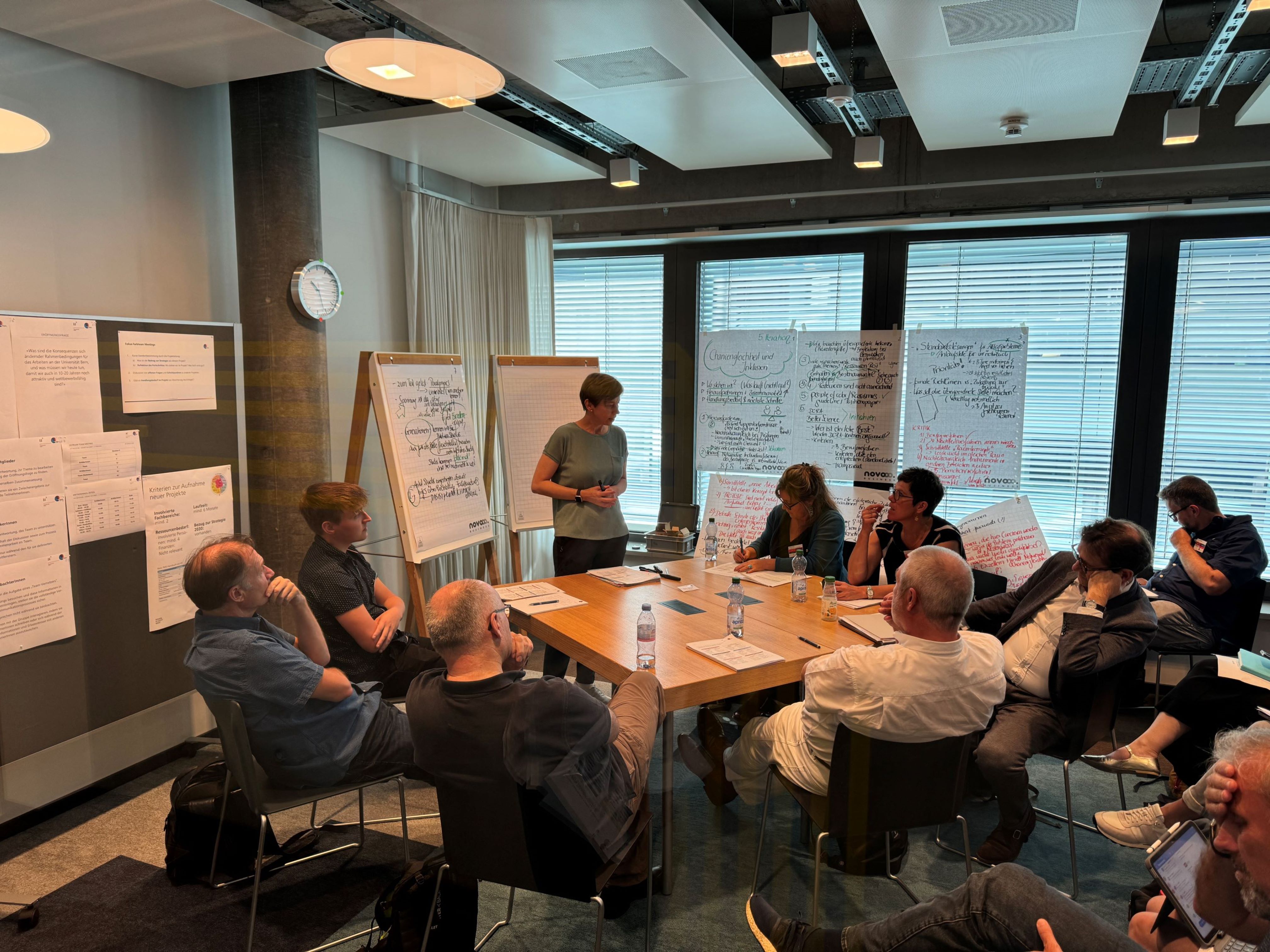
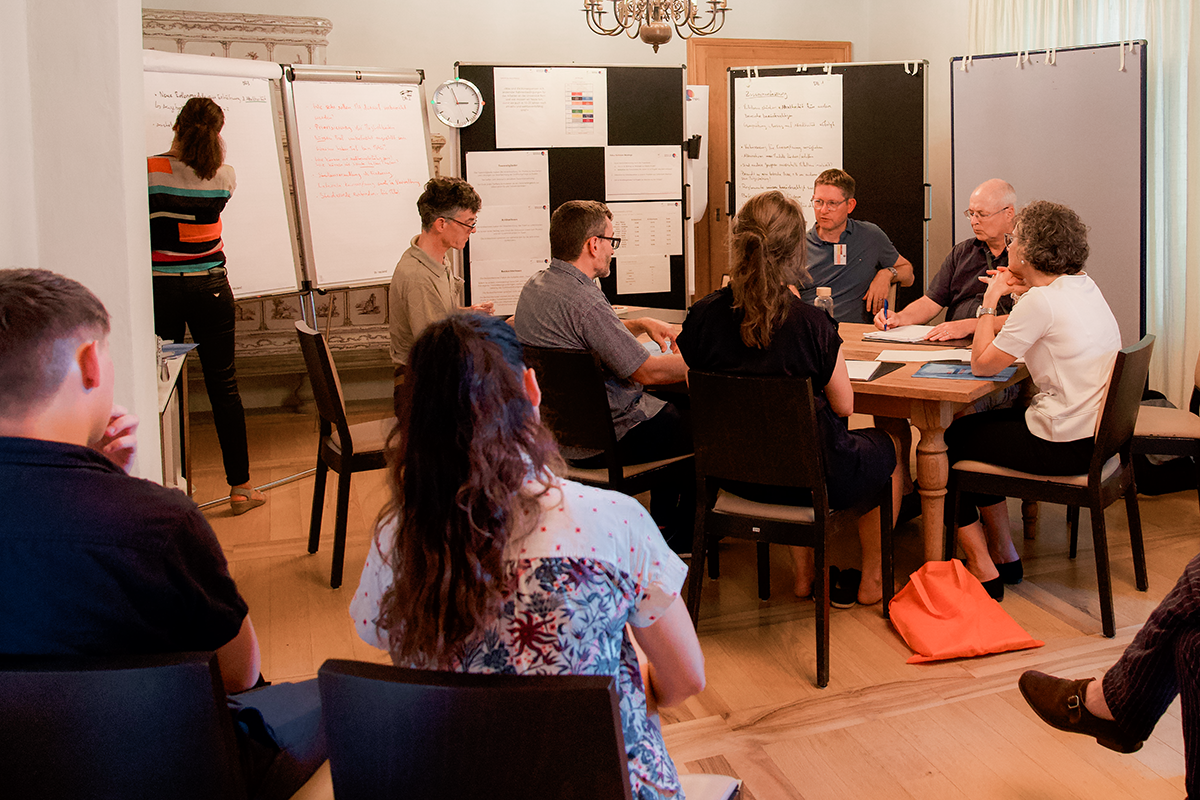
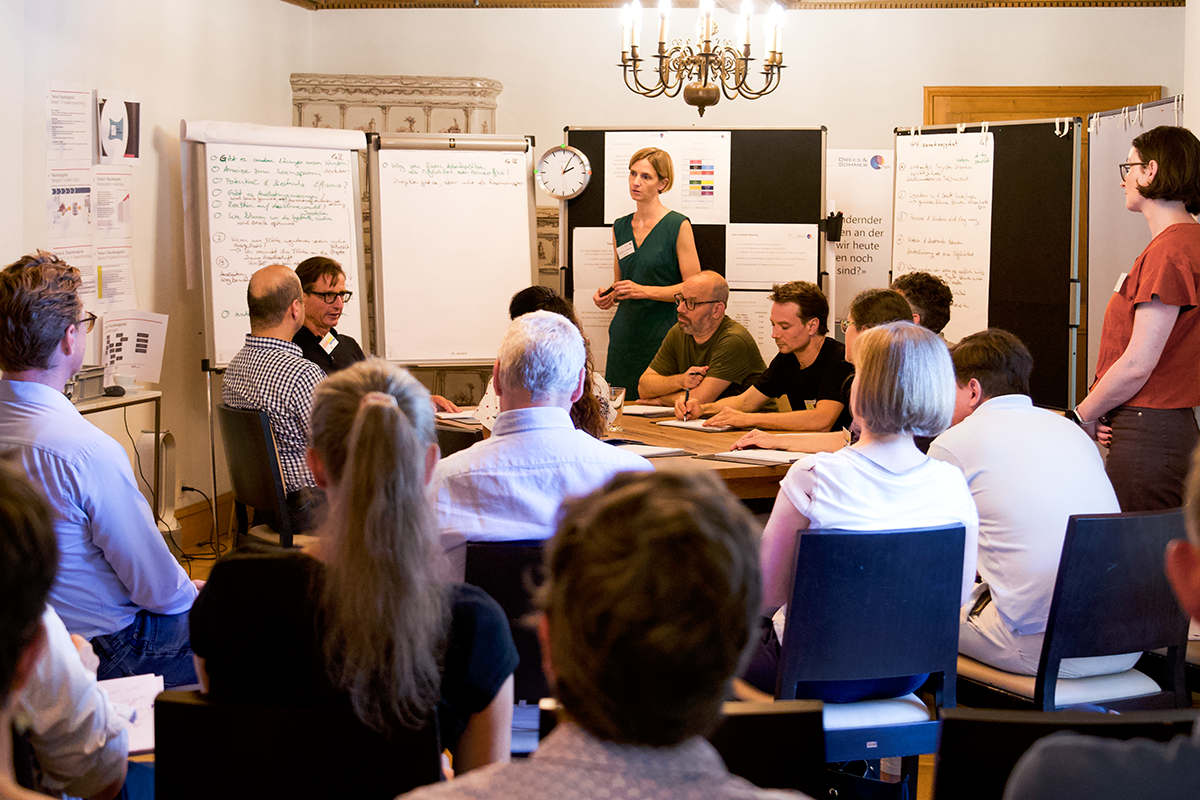
More than 40 people from the faculties, the central division, the MVUB and the SUB discussed the interim status of the "Fit for Future" program in a one-day workshop.
The mood of optimism was palpable, the discussions open and lively. The biggest challenges facing the university(s) were discussed and opportunities for improvement were identified. "What do we need to do today to ensure that the University will still be competitive in 20 years?" was the initial question at the 3-day workshop last July. On August 22, representatives of the University of Bern met for the so-called 4th iteration to further discuss the initial question. The stated goal of this day was to examine whether the planned projects in the total of twelve fields of action are on track and where adjustments may be needed so that the university can actively address the challenges of the future.
One of the central results of the workshop was the realization that even more bridges need to be built between the various projects and fields of action, because the challenges can usually only be solved across project and organizational boundaries. In particular, the collaboration between faculties and the central department was named by the participants as a critical factor for the success of the program.
Details: What was discussed?
As mentioned at the beginning, the University of Bern wants to position itself for the future through numerous projects as part of the Fit for Future program and remain attractive as a teaching and research institution as well as an employer. This should be achieved, for example, by making the university's structures more uniform and thus simplifying administrative processes. At the same time, a balance must be found between the autonomy of the faculties and the guidelines set by the administration.
In the process, professionalization at the management level is also to be achieved. This should be strengthened, among other things, through the further development of the leadership culture and already begin with the recruitment process, in which leadership competencies are already taken into account.
Despite heterogeneity, the university should also guarantee uniform employment conditions and promote and retain its employees. In particular, career planning within the university for mid-level faculty must be strengthened.
All employees should be involved in the many upcoming changes. This applies in particular to the digital transformation, which is a challenge for many, but will achieve improvements and simplifications in many areas. But the new workplace concepts also require a new mindset from university employees. The group is certain that all this will, however, also offer many opportunities. However, the readiness for change must be promoted through adequate change management.
The members of the university should feel connected to the university and its values and feel that it offers equal opportunities to all and acts inclusively. In this context, exchange in general and especially between the stands and university units should be promoted. It is also particularly important here to bridge the gap between the central area and the faculties.
In teaching, there is a need for forums at a higher level for the discussion of fundamental questions, such as how teaching should be organized and what structures are needed for this. The necessary changes should be initiated to make teaching attractive for students and to promote interdisciplinarity. For researchers, central contact points and an innovative environment are needed to promote entrepreneurship. Through this and by making research results visible via visual global maps, the university achieves greater resonance with the public. At the same time, the local roots should not be forgotten, even if research often takes place on the international stage.
What's next?
Another exchange in the coming year will provide the opportunity to review the status of the projects again, to exchange further experiences and to make adjustments if necessary. The University of Bern remains focused on creating, step by step, a future-oriented educational institution that meets the demands of the times.
1. - 3. Iteration (2022)
Shaping the future of the university
What do we need to do today to ensure that the university remains competitive in 20 years' time? Forty people from the central administration, the faculties, the MVUB, the SUB, the cantonal administration and politics worked on this question and developed 30 concrete starting points in 12 subject areas.
"The will to actively shape the future is definitely there," said Administrative Director Markus Brönnimann at the end of the workshop. Under his leadership, the University of Bern wants to find out how it can actively address upcoming challenges and constantly changing conditions. The participants also shared this positive conclusion – but at the same time agreed that it was exhausting and demanding.
For three and a half days, they reflected, discussed together and listened intently. Under the leadership of the Oroborus Foundation and with the support of the consulting firm Drees & Sommer, the participants used the ‘Syntegration’ method to capture and consolidate their knowledge and discussions and turn them into usable results.
At the beginning, the participants agreed on what they considered to be the 12 most important topics and, over the following three days, first formulated the current situation, then their vision and finally the concrete approaches that are now to be actively pursued.
Essentially, the following approaches were developed for the following areas:
- Rethinking university structures
- Shortage of space
- UniBE Life
- Equal opportunities
- Innovation/Translation
- Leadership culture and change
- Teaching
- Life-long-learning
- New workplace concepts
- Conditions of employment
- Digital Transformation
- International research environment
Concrete approaches have been developed for these areas and individuals have been appointed to drive the measures forward. The implementation organisation will be determined over the summer.
The success of the Syntegration workshop is therefore clear to see, and this is also true in other respects: "I have been working at the university for two and a half years now, and in these three and a half days I have probably learned more about the university than ever before," said Christian von Büren from the Administrative Directorate, praising in particular the exchange with the many different participants. Achim Elfering from the Institute of Psychology echoed this sentiment in the feedback round: "I believe we now share much more with each other." And accordingly, all participants agreed on one thing in particular: exchange within the university must be conducted and promoted much more frequently and intensively.